The global non-destructive testing and inspection market stands at a critical macro-valuation milestone, having achieved a verified baseline of 15.50 billion dollars in 2025 and projecting an aggressive growth path toward 34.72 billion dollars by 2035. This trajectory is governed by a robust compound annual growth rate of 8.4 percent across the 2026 to 2035 forecast period, positioning non-destructive testing as an essential board-level priority rather than a mere operational line item. At the root of this capital expansion is the urgent necessity to preserve and optimize capital-intensive industrial assets operating under increasingly arduous stress conditions. Operating at the foundational core of global supply chains, non-destructive testing serves as the primary barrier against catastrophic infrastructure failure, unbudgeted operational downtime, and severe regulatory non-compliance. Consequently, institutional investors and corporate strategists are re-evaluating this asset class as a high-margin, defensive yield engine within the broader capital goods and industrial services matrix.
Inextricably linked to this financial surge is the broader macroeconomic environment, where rising interest rates and tight capital markets have forced enterprise asset operators to extend the operational lifespans of aging physical infrastructure. Rather than committing massive capital expenditures to greenfield facility construction, global industrial conglomerates are allocating budget toward high-precision structural integrity assessment. This strategic reallocation of capital ensures that legacy pipelines, power generation plants, and aerospace fleets remain operational well beyond their original design lifecycles without compromising baseline safety parameters. The economic rationale is straightforward, as the marginal cost of advanced non-destructive inspection represents a tiny fraction of the potential capital destruction associated with structural breach or unscheduled facility shutdowns. As a result, capital flows into advanced diagnostic technologies have accelerated, transforming routine maintenance routines into highly sophisticated corporate risk mitigation frameworks.
Building upon this macroeconomic foundation, the strategic valuation of non-destructive testing is further elevated by its seamless integration into enterprise risk management frameworks. Modern corporate governance standards increasingly hold executive leadership personally and financially accountable for environmental, health, and safety breaches, turning asset integrity verification into a non-negotiable fiduciary duty. The shift from periodic, calendar-based manual inspections to continuous, risk-based inspection protocols reflects a fundamental realignment of operational priorities. Institutional asset managers recognize that companies employing continuous diagnostic monitoring achieve higher operational efficiency, lower insurance premiums, and superior capital utilization metrics. Therefore, the market for non-destructive inspection has evolved from an auxiliary technical service into a strategic pillar of operational resilience and corporate longevity.
Dissecting the business clinic diagnostic reveals that the industry is undergoing a profound structural shift driven by the convergence of digital sensors, robotics, and artificial intelligence. Legacy manual testing techniques are rapidly ceding market share to automated defect recognition systems and autonomous robotic inspection crawlers capable of operating in high-hazard environments. The integration of machine learning algorithms with phased array ultrasonic testing and digital radiography has dramatically reduced human error while accelerating data processing speeds by orders of magnitude. This technical inflection point alters the cost structure of inspection service providers, shifting the labor-to-technology cost ratio toward high-margin software-enabled analytical platforms. Consequently, equipment manufacturers that fail to embed cloud connectivity and edge-computing artificial intelligence into their hardware suites face rapid margin compression and technological obsolescence.
Compounding this structural evolution are severe supply chain complexities and component price volatilities that impact equipment manufacturing and deployment. High-end non-destructive testing instruments rely heavily on specialized piezoelectric transducers, advanced radiation detectors, and high-performance semiconductor chips, all of which remain subject to global supply chain friction and localized trade tariffs. These hardware supply bottlenecks have inflated initial capital equipment costs, creating a distinct barrier to entry for smaller service providers and accelerating fleet consolidation among tier-one operators. Furthermore, raw material price fluctuations in specialized alloys and shielding materials have driven manufacturers to pass cost increases onto enterprise end-users through dynamic equipment pricing models. Enterprise buyers are subsequently forced to optimize their procurement lifecycles, balancing high capital expenditure equipment acquisitions against long-term operational expenditure service agreements.
Simultaneously, the industry faces an acute human capital crisis characterized by an escalating global shortage of certified Level II and Level III non-destructive testing technicians. As a significant portion of the experienced workforce reaches retirement age, the pipeline of qualified technical talent has failed to keep pace with expanding industrial demand. This profound labor bottleneck has driven certified technician wage inflation to historic highs, severely squeezing operating margins for pure-play inspection service firms. To mitigate this workforce constraint, enterprise asset owners are demanding automated, intuitive, and remote inspection systems that allow a single expert technician to oversee multiple automated testing operations concurrently. The operational impact of this labor dynamic is profound, accelerating the adoption of autonomous drones, subsea remote operated vehicles, and automated crawler systems across offshore platforms, manufacturing facilities, and pipeline networks.
Regulatory frameworks and environmental sustainability mandates represent an additional layer of operational disruption across the global market landscape. International regulatory bodies governing pressure vessels, civil aviation, and nuclear energy are continuously tightening non-destructive testing standards, mandating higher spatial resolution and digital record auditability. Concurrently, environmental regulations are forcing a rapid phase-out of traditional chemical film radiography due to toxic chemical waste disposal issues, compelling industrial facilities to transition toward digital radiography and computed tomography solutions. While this regulatory pivot requires substantial initial capital investment, it fundamentally improves operational turnaround times, eliminates environmental disposal liabilities, and provides permanent digital data records required for digital twin modeling and long-term structural health tracking.
Examining the mechanics of segment propulsion reveals that the market is bifurcated into high-volume recurring inspection services and capital-intensive precision testing hardware. The service segment commands the dominant revenue share, sustained by long-term Master Service Agreements between industrial plant operators and specialized third-party inspection firms. Industrial asset owners increasingly prefer outsourcing asset integrity management to avoid the heavy balance sheet burden of maintaining expensive specialized equipment fleets and specialized technical staff. These multi-year service contracts provide inspection vendors with highly predictable, inflation-indexed cash flows while creating immense switching friction for asset owners who rely on established vendor compliance data histories.
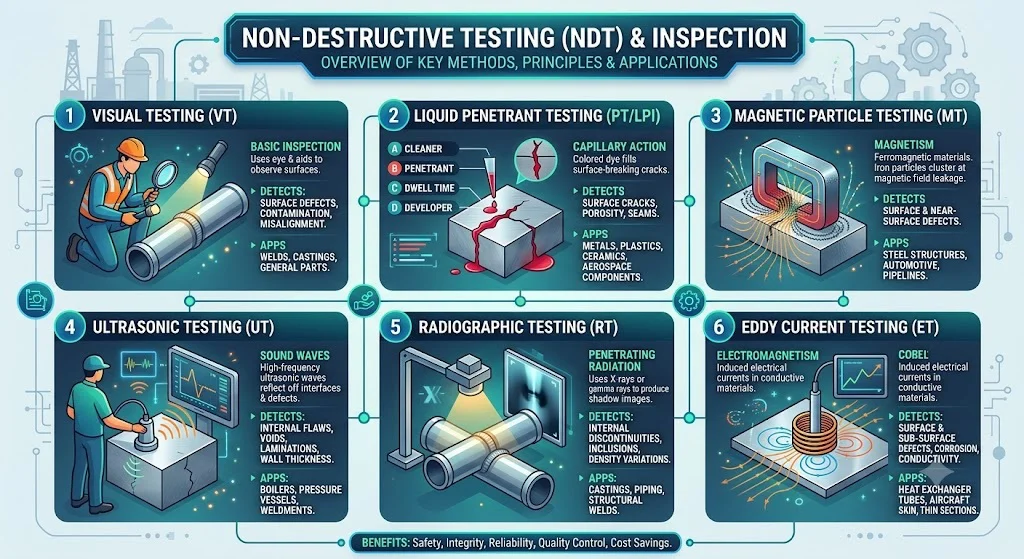
Within the technological equipment segmentation, a clear structural divergence exists between legacy surface testing methods and advanced volumetric testing technologies. Traditional methods such as liquid penetrant testing and magnetic particle testing maintain high market volume due to their low equipment costs and procedural simplicity, but they yield relatively modest operating margins. Conversely, advanced volumetric technologies, including phased array ultrasonic testing, time-of-flight diffraction, and digital industrial radiography, command premium pricing structures and deliver substantially higher profit margins. The superior defect sizing accuracy and volumetric mapping capabilities of these advanced techniques make them indispensable for high-stakes applications in nuclear power plants, aerospace structures, and high-pressure hydrogen transport systems where minor material flaws can trigger catastrophic failures.
A particularly lucrative growth vector is emerging in the domain of continuous Structural Health Monitoring, which utilizes permanently installed acoustic emission sensors and fiber-optic grids. Unlike traditional intermittent inspection routines, structural health monitoring systems provide real-time, continuous data feeds detailing micro-crack propagation, stress deformation, and corrosion rates in critical load-bearing assets. This transition from periodic inspection to continuous real-time monitoring represents a fundamental shift in buyer purchasing behavior, unlocking high-margin software-as-a-service revenue models for pioneering technology providers. As enterprise buyers seek to integrate real-time structural health data directly into their enterprise resource planning platforms, non-destructive testing transitions from an occasional operational expense into an integrated, value-generating asset management asset.
The economic and operational forces governing buyer behavior create substantial barriers to switching and lock-in effects across end-user industries. Once an enterprise asset owner integrates a specific non-destructive testing software platform and hardware architecture into their digital twin environment, substituting vendors introduces severe operational risk and compliance re-certification costs. Furthermore, proprietary data formats and proprietary sensor calibration algorithms lock clients into long-term vendor ecosystems. Consequently, early-mover technology providers who successfully embed their diagnostic software into enterprise workflows capture recurring high-margin analytical contracts, insulating themselves from price-based competition and low-cost alternative offerings.
Spatial analysis of the global marketplace underscores significant regional divergence dictated by infrastructure age, industrial capital expenditure, and local regulatory enforcement. North America continues to represent a premier high-value revenue pool, driven by an aging network of midstream energy pipelines, an expanding commercial aerospace manufacturing sector, and strict federal safety regulations mandating rigorous pipeline integrity management. The regional market is characterized by high adoption rates of advanced automated ultrasonics and digital radiography as operators seek to reduce high regional labor costs through technological automation. Similarly, European market dynamics are heavily influenced by stringent environmental safety regulations, rapid offshore wind infrastructure development, and a structural pivot toward nuclear energy life extension projects, all of which require specialized high-precision non-destructive evaluation.
In sharp contrast, the Asia-Pacific region serves as the primary engine of volume growth, powered by rapid state-led infrastructure expansion, massive urban building construction, and expanding heavy manufacturing bases. The continuous buildout of nuclear power reactors, high-speed rail networks, and mega-shipbuilding yards across major regional economies generates immense demand for both high-throughput surface testing and advanced volumetric inspection systems. While price sensitivity remains higher in developing Asia-Pacific sub-markets compared to Western economies, the sheer scale of capital investment and industrial production provides unmatched volume opportunities for equipment manufacturers and inspection service providers capable of delivering cost-effective, scalable testing solutions.
Meanwhile, the Middle East, Africa, and Latin America present highly concentrated, high-margin opportunities centered primarily on energy extraction, downstream refining, and mining infrastructure. In the Middle East and Africa, massive capital allocations toward offshore oil and gas production, LNG export terminals, and green hydrogen production facilities require non-destructive testing equipment engineered to withstand extreme ambient temperatures and highly corrosive desert or subsea environments. Latin America displays a parallel trajectory, where deepwater oil exploration and large-scale copper and lithium mining operations drive demand for specialized subsea and heavy-duty structural testing services. Regions with challenging operating environments consistently yield higher service margins for vendors possessing specialized equipment capable of autonomous remote operation.
For executive leadership and corporate strategists, the cost of strategic inertia in this rapidly evolving landscape is severe and immediate. Failing to adapt corporate asset integrity strategies to incorporate automated, continuous, and AI-driven non-destructive inspection technologies guarantees progressive margin erosion and heightened catastrophic risk exposure. Organizations that rely on legacy manual testing procedures face soaring labor expenditures, extended facility downtime, and increasing vulnerability to regulatory penalties or catastrophic asset failures. Conversely, proactive market leaders who align their capital expenditure strategies with advanced digital inspection frameworks secure a permanent competitive advantage through optimized operational costs and extended asset working lives.
Navigating this complex industrial landscape requires corporate leaders to execute precise strategic bets across technological adoption, regional expansion, and service delivery models. Decision-makers must accurately balance high initial capital expenditures for advanced automated testing suites against long-term operational efficiency gains and technician labor savings. Furthermore, evaluating potential target markets, optimizing pricing models, and identifying high-margin application niches requires detailed, empirical market intelligence that goes far beyond surface-level industry overviews or generalized growth estimates.
Ultimately, unlocking sustained profitability and market leadership in the non-destructive testing and inspection space demands granular, institutional-grade analytical visibility. Successfully capitalizing on shifting regional demand pools, changing buyer procurement behaviors, and accelerating technological convergence requires access to detailed competitive position matrices, precise pricing trend indices, and comprehensive country-level forecasting models. All of these actionable insights, structural data breakdowns, and long-term valuation frameworks are exhaustively mapped and rigorously analyzed within the complete, institutional-grade global Non-Destructive Testing and Inspection market research report.