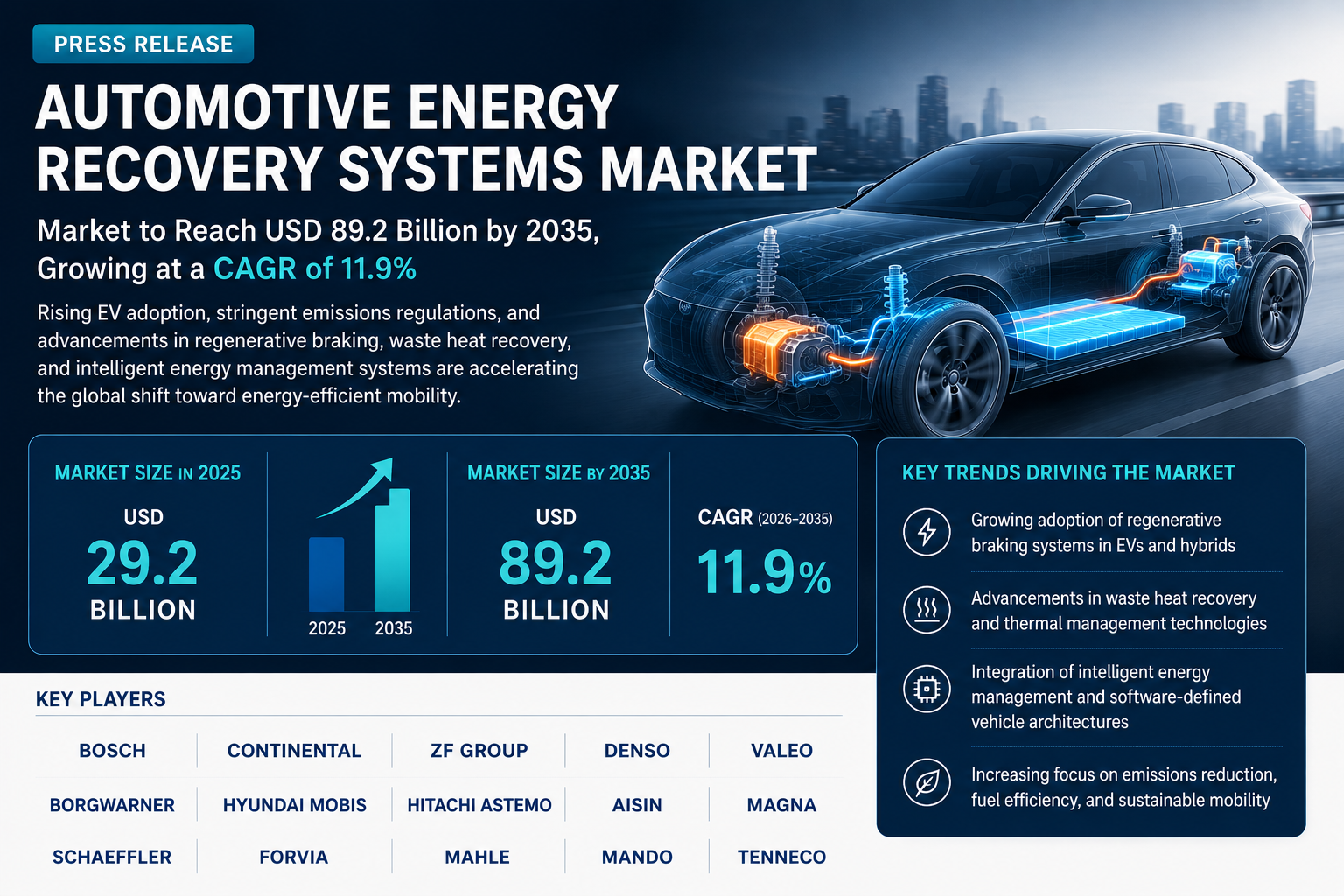
According to analysts at Market Business Insights, the Global Automotive Energy Recovery Systems Market size is worth USD 29.2 Billion in 2025 and is projected to reach USD 89.2 Billion by 2035, growing at a CAGR (Compound Annual Growth Rate) of 11.9% from 2026 to 2035. The market is driven by electric vehicle expansion, stringent emissions regulations, regenerative braking adoption, thermal efficiency optimization, fleet fuel-economy requirements, software-integrated energy management systems, and automotive drivetrain electrification investments globally.
Automotive Energy Recovery Systems Market Overview
The global Automotive Energy Recovery Systems market is witnessing accelerated expansion as automakers intensify investments in fuel-efficiency optimization, vehicle electrification, and intelligent drivetrain technologies. Energy recovery systems, including regenerative braking, waste heat recovery, and advanced thermal management technologies, are becoming integral to modern vehicle architectures because they improve energy utilization while reducing emissions and operational energy loss. The transition toward electric and hybrid mobility platforms is further strengthening demand for energy recovery technologies capable of extending driving range and improving overall vehicle efficiency.
Automotive manufacturers are increasingly integrating software-driven energy management systems into passenger and commercial vehicle platforms to comply with tightening global emissions regulations and evolving fuel-economy standards. Commercial fleet operators are also adopting energy recovery technologies to reduce lifecycle operating costs and enhance drivetrain performance under high-utilization operating conditions. In parallel, advancements in power electronics, thermal conversion systems, and brake-by-wire technologies are reshaping competitive dynamics across the automotive efficiency ecosystem.
Asia Pacific continues to dominate the Automotive Energy Recovery Systems market due to large-scale electric vehicle production, expanding urban mobility infrastructure, and strong regulatory support for low-emission transportation technologies. Meanwhile, Europe and North America remain strategically important markets driven by premium vehicle electrification, advanced automotive engineering capabilities, and increasing investments in software-defined mobility platforms.
Continental Strengthens Electrified Mobility Strategy with AUMOVIO Repositioning
- In July 2025, Continental announced the strategic repositioning of its Automotive group sector under the AUMOVIO identity, focusing on future mobility technologies including electric vehicle brake systems, intelligent vehicle-control architectures, and software-integrated mobility solutions. The company emphasized scalable brake technologies designed specifically for electrified vehicle platforms and advanced energy-efficiency applications.
Key Takeaways from the Report
- Regenerative braking systems accounted for the largest revenue share in 2025 due to rising deployment across electric and hybrid vehicle platforms.
- Waste heat recovery and advanced thermal conversion technologies emerged as the fastest growing technology segment.
- Passenger vehicles contributed the highest demand share, while commercial fleet applications demonstrated accelerated adoption momentum.
- Hybrid electric vehicles maintained strong integration rates because of multi-source energy recapture capabilities.
- Asia Pacific dominated global demand driven by electric vehicle manufacturing expansion and tightening fuel-efficiency regulations.
- Software-defined vehicle architectures and intelligent energy management systems are reshaping competitive differentiation across automotive OEMs.
- Automotive manufacturers are prioritizing integrated energy optimization ecosystems over standalone efficiency components.
- Long-term market expansion is being reinforced by emissions compliance mandates, urban mobility electrification, and fleet operating cost optimization strategies
Top Players
- Robert Bosch GmbH
- Continental AG
- ZF Friedrichshafen AG
- Denso Corporation
- Valeo SA
- Hyundai Mobis
- BorgWarner Inc.
- Hitachi Astemo Ltd.
- Aisin Corporation
- Magna International Inc.
- Schaeffler AG
- Forvia
- Mahle GmbH
- Mando Corporation
- Tenneco Inc.
Report Coverage
Our market research reports provide comprehensive insights that are essential for strategic decision-making. We cover all key aspects of the market, including dynamics such as drivers, restraints, opportunities, and challenges, alongside the latest industry trends. Our analysis includes an in-depth technology roadmap, product life cycle evaluation, and PESTLE analysis, ensuring a thorough understanding of the market environment. We also assess GDP growth outlooks, examine regional market landscapes, and evaluate the impact of major events like the COVID-19 pandemic. Additionally, our reports feature a detailed competitive landscape, including company market shares and profiles, providing actionable intelligence to empower your business strategies.
Latest Announcement
- In 2025, Bosch successfully completed public-road validation trials for its hydraulic brake-by-wire system intended for next-generation electric and hybrid vehicles. The technology removes the mechanical connection between the brake pedal and braking system, enabling improved regenerative braking integration, faster electronic response, and enhanced energy recovery efficiency. Bosch confirmed market launch plans for late 2025 and indicated strong OEM order visibility.