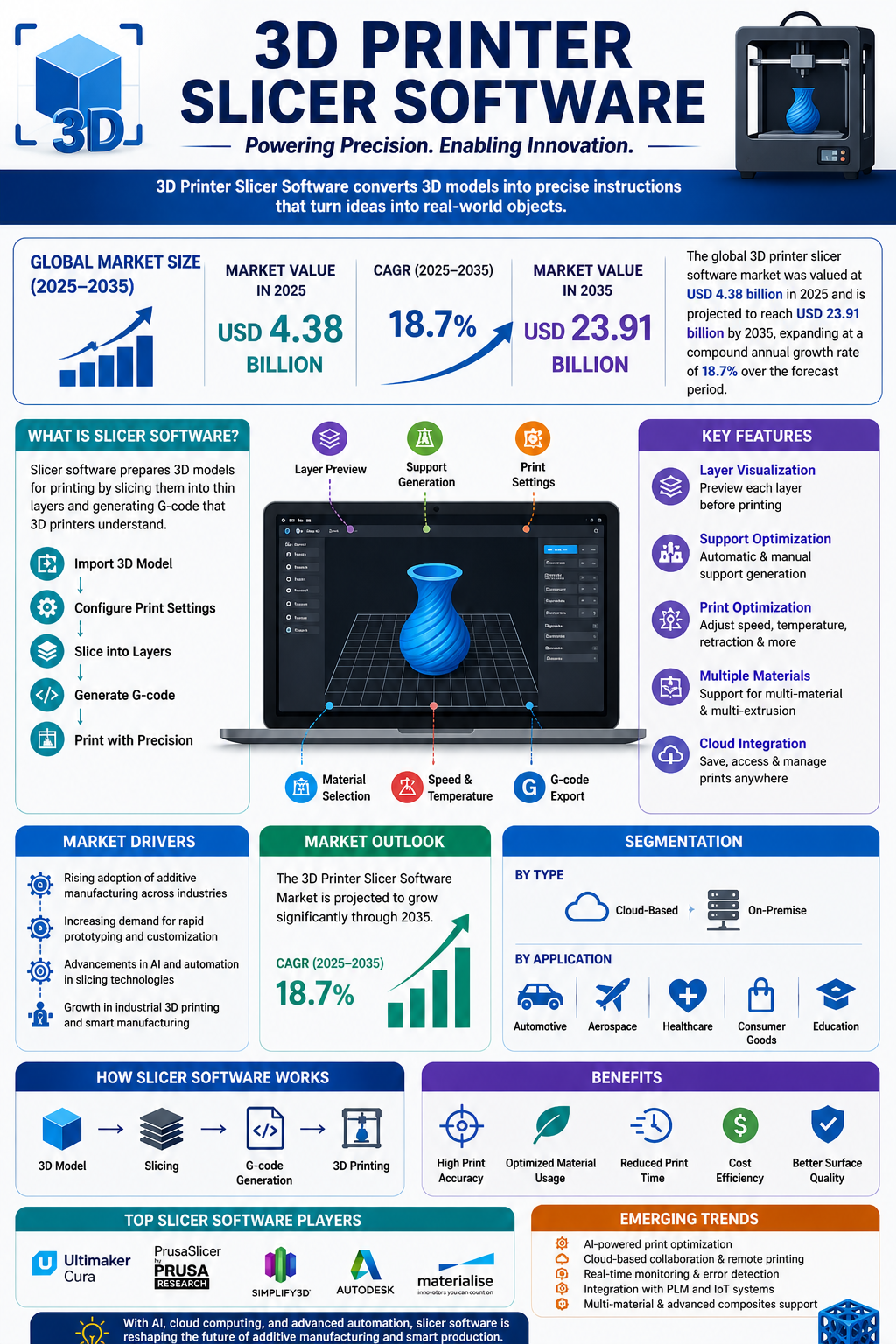
The global 3D Printer Slicer Software Market is witnessing strong growth due to the increasing adoption of additive manufacturing technologies across automotive, aerospace, healthcare, education, and industrial production sectors. Slicer software plays a critical role in converting 3D models into machine-readable instructions, enabling precise and efficient printing operations. Rising demand for customized manufacturing and rapid prototyping is accelerating software innovation worldwide.
The market is also benefiting from advancements in artificial intelligence, cloud-based slicing platforms, real-time simulation tools, and automated print optimization technologies. As industries move toward Industry 4.0 and smart manufacturing ecosystems, companies are investing heavily in advanced slicing solutions that improve printing accuracy, reduce material waste, and enhance production speed. Asia-Pacific and North America continue to emerge as key growth regions due to increasing industrial automation and expanding 3D printing infrastructure.
What is the 3D Printer Slicer Software Market?
The 3D Printer Slicer Software Market refers to the global industry focused on software solutions that convert 3D design files into printable layer-by-layer instructions for 3D printers. These solutions optimize printing speed, material usage, and print quality while supporting advanced manufacturing applications across industrial, medical, aerospace, automotive, and consumer sectors.
3D Printer Slicer Software Market Overview
The global 3D Printer Slicer Software Market is expected to experience substantial expansion during the forecast period through 2033. The market growth is being fueled by increasing industrial adoption of 3D printing technologies and the growing need for precise digital manufacturing processes. Slicer software has become an essential component of modern additive manufacturing workflows because it directly impacts printing quality, production efficiency, and material optimization.
Manufacturers are increasingly integrating AI-powered slicing tools to automate support generation, optimize print orientation, and improve layer management. These technologies help reduce production costs while increasing operational productivity. Industries such as aerospace and healthcare are adopting advanced slicing platforms for complex component manufacturing and customized medical device production.
Key Takeaways
- Rising industrial 3D printing adoption is boosting demand.
- AI-based slicing technologies are improving automation.
- Cloud deployment models are becoming increasingly popular.
- Healthcare and aerospace sectors remain major end users.
- Asia-Pacific is emerging as a high-growth regional market.
3D Printer Slicer Software Market Dynamics
Drivers
Growing Adoption of Industrial 3D Printing
Industrial manufacturers are increasingly utilizing 3D printing for rapid prototyping, tooling, and end-use part production. This trend is significantly increasing demand for advanced slicer software capable of handling complex geometries and industrial-scale production requirements. Modern slicer solutions improve print accuracy, minimize waste, and optimize machine efficiency.
Automotive and aerospace industries are particularly driving software demand due to the need for lightweight components and faster production cycles.
Key Points
- Higher production efficiency
- Faster product development
- Improved design flexibility
- Reduced manufacturing costs
Restraints
Software Compatibility Challenges
One of the major restraints affecting the market is compatibility issues between different 3D printer models and slicing platforms. Many organizations operate mixed printer environments, making software integration difficult and increasing workflow complexity.
Frequent software updates and hardware-specific configurations can also create operational inefficiencies for small and medium-sized enterprises.
Opportunities
AI-Based Automated Slicing Solutions
Artificial intelligence is creating major growth opportunities in the market. AI-driven slicing software can automatically detect printing errors, optimize support structures, and improve layer precision without manual intervention.
These technologies help manufacturers reduce downtime, improve print consistency, and enhance productivity across industrial operations.
Challenges
Lack of Skilled Technical Workforce
Despite growing market adoption, many industries still face a shortage of professionals skilled in additive manufacturing software operations. Advanced slicer tools require technical expertise in print settings, material science, and machine calibration.
Training and workforce development remain essential for long-term industry growth.
Top Trends in the 3D Printer Slicer Software Market
AI-Integrated Slicer Platforms
AI-enabled slicing tools are becoming increasingly common across industrial manufacturing environments. These platforms automate print optimization processes and reduce human intervention, improving operational efficiency and print reliability.
Cloud-Based Slicing Software
Cloud deployment models are gaining popularity because they allow remote access, centralized management, and collaborative printing workflows. Businesses are increasingly adopting cloud-based platforms to support distributed manufacturing operations.
Open-Source Slicer Adoption
Open-source slicing platforms are witnessing strong adoption among educational institutions, hobbyists, and small businesses. These solutions provide flexibility, community-driven innovation, and lower implementation costs.
Multi-Material Printing Support
Modern slicer software is evolving to support multi-material and multi-color printing applications. This trend is enabling more advanced product development and customized manufacturing capabilities.
Real-Time Simulation Features
Simulation technologies are helping manufacturers visualize printing outcomes before production begins. These tools reduce material waste, prevent print failures, and improve overall operational efficiency.
3D Printer Slicer Software Market Segmentation
By Type
Cloud-Based
Cloud-based slicer software solutions are gaining traction due to their scalability, remote accessibility, and integration capabilities. These platforms support collaborative workflows and centralized production management.
On-Premise
On-premise solutions remain popular among industries requiring enhanced data security and greater operational control. Large enterprises often prefer locally deployed software for sensitive manufacturing processes.
By Application
Automotive
Automotive manufacturers use slicer software for rapid prototyping, lightweight component production, and customized tooling applications.
Aerospace
The aerospace sector utilizes advanced slicing solutions for precision manufacturing and complex structural component production.
Healthcare
Healthcare organizations adopt 3D printing software for surgical planning, prosthetics, implants, and customized medical devices.
Consumer Goods
Consumer product manufacturers are increasingly using additive manufacturing for product customization and rapid product development.
Education
Educational institutions are integrating 3D printing technologies into engineering, design, and technical training programs.
Regional Insights
North America
North America dominates the market due to strong technological infrastructure, early adoption of additive manufacturing, and significant investments in industrial automation. The United States remains a leading contributor due to the presence of major software developers and aerospace manufacturers.
Europe
Europe is witnessing steady growth driven by automotive innovation, smart manufacturing initiatives, and increasing industrial digitalization. Germany, France, and the United Kingdom are major regional contributors.
Asia-Pacific
Asia-Pacific is projected to register the fastest growth during the forecast period. China, Japan, South Korea, and India are investing heavily in industrial automation and advanced manufacturing technologies.
Latin America
Latin America is gradually adopting 3D printing technologies across healthcare, automotive, and educational sectors. Brazil and Mexico remain key regional markets.
Middle East & Africa
The Middle East & Africa region is experiencing moderate growth due to rising investments in industrial diversification and smart manufacturing initiatives.
Competitive Landscape
The global market remains highly competitive with companies focusing on AI integration, cloud deployment, automation, and advanced simulation technologies.
Major Players
- Ultimaker Cura
- PrusaSlicer
- Simplify3D
- Autodesk
- Materialise
- Raise3D
- ideaMaker
- Fusion 360
Key Competitive Strategies
- Product innovation
- AI integration
- Strategic partnerships
- Cloud platform expansion
- Industry-specific software development
Recent Industry Developments
- January 2026 – Several manufacturers introduced AI-powered print optimization features.
- March 2026 – Cloud-based slicing platforms expanded enterprise collaboration tools.
- June 2026 – Major software vendors integrated real-time print simulation technologies.
- September 2026 – Companies increased investments in industrial automation software ecosystems.
Future Outlook of the 3D Printer Slicer Software Market
The future of the market appears highly promising as industries continue embracing smart manufacturing technologies and digital production ecosystems. AI, machine learning, and automation are expected to transform slicer software capabilities by improving predictive analysis, automated calibration, and print quality optimization.
The integration of digital twin technologies and Industry 4.0 systems will further strengthen industrial adoption. Cloud computing, remote production management, and multi-material printing innovations are likely to drive future market expansion.
As manufacturing processes become increasingly data-driven, slicer software providers are expected to focus heavily on intelligent workflow automation and scalable production management solutions.
Report Scope
The global 3D Printer Slicer Software Market is expected to witness substantial growth through 2033 due to increasing adoption of additive manufacturing technologies across multiple industries. AI-powered slicing solutions, cloud-based deployment models, and smart manufacturing initiatives are reshaping the competitive landscape.
Growing demand for production efficiency, customization, and digital manufacturing capabilities will continue supporting long-term market expansion. Companies investing in advanced automation and intelligent printing technologies are likely to gain significant competitive advantages in the evolving global market.
Frequently Asked Questions
What is 3D printer slicer software?
3D printer slicer software converts digital 3D models into layer-by-layer instructions that 3D printers use to manufacture physical objects accurately and efficiently.
What drives the growth of the market?
The market is primarily driven by rising industrial 3D printing adoption, AI-based automation, smart manufacturing investments, and increasing demand for customized production.
Which industries use slicer software?
Industries including automotive, aerospace, healthcare, education, and consumer goods widely use slicer software for manufacturing and prototyping applications.
Why is AI important in slicer software?
AI improves print optimization, reduces material waste, automates support generation, and enhances production efficiency in additive manufacturing processes.
Which region dominates the market?
North America currently dominates the market due to strong technological infrastructure and early adoption of additive manufacturing technologies.
What are cloud-based slicer platforms?
Cloud-based slicer platforms allow users to manage printing operations remotely through internet-connected systems, improving collaboration and workflow efficiency.
What are the major market trends?
Major trends include AI integration, cloud deployment, real-time simulation, multi-material printing support, and open-source software adoption.
What challenges affect market growth?
Key challenges include software compatibility issues, high implementation complexity, and shortages of skilled additive manufacturing professionals.
Who are the leading market players?
Leading companies include Ultimaker Cura, PrusaSlicer, Simplify3D, Autodesk, Materialise, and Raise3D.
What is the future outlook of the market?
The future outlook remains highly positive due to increasing industrial automation, AI advancements, smart manufacturing adoption, and Industry 4.0 integration.