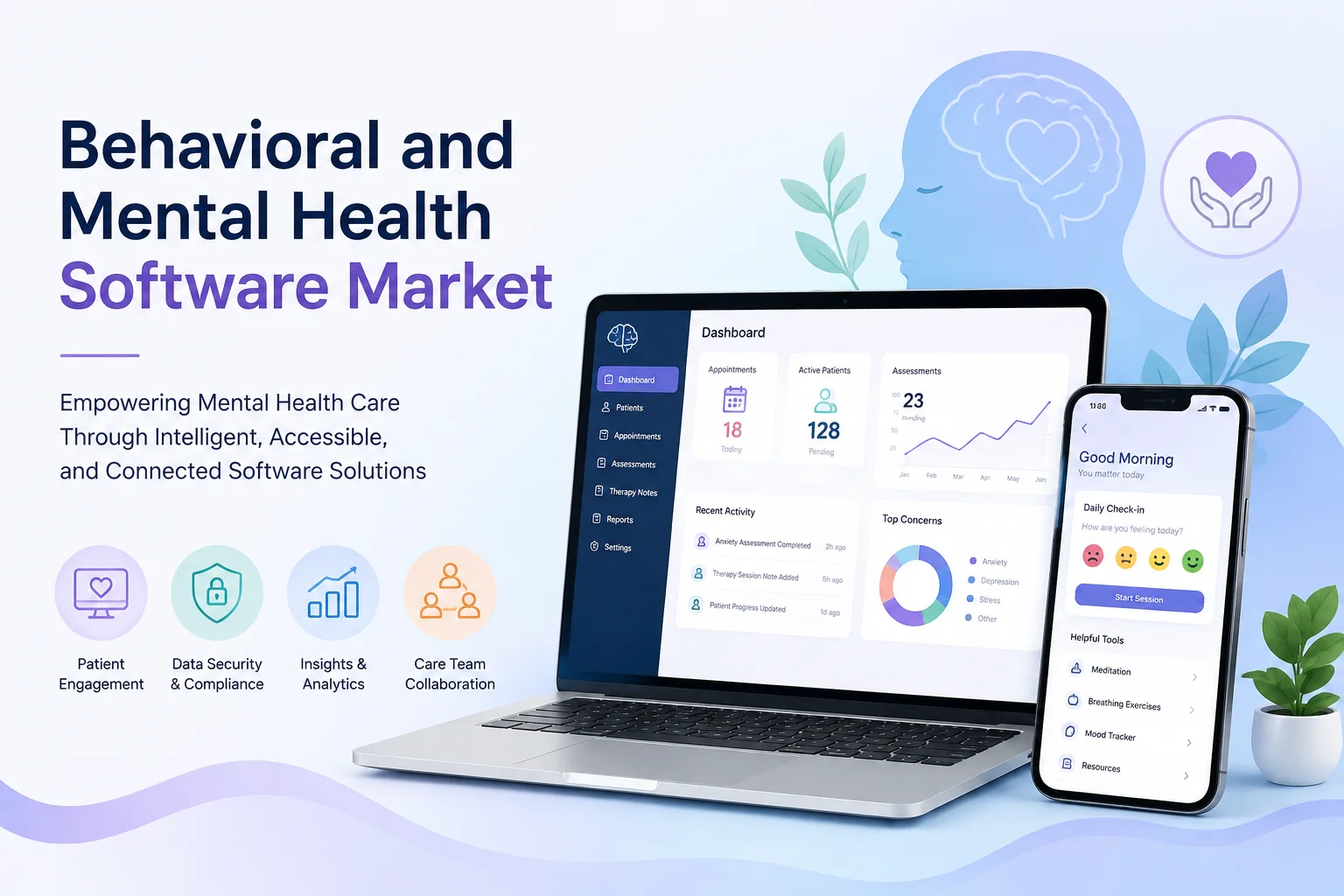
According to analysts at Market Business Insights, the Global Behavioral and Mental Health Software Market size was estimated at USD 4.82 Billion in 2025 and is projected to reach USD 12.94 Billion by 2035, growing at a CAGR (Compound Annual Growth Rate) of 10.4% from 2026 to 2035. Key trends include growing adoption of cloud-based behavioral health platforms, integrated care delivery, artificial intelligence-enabled clinical decision support, predictive analytics, telebehavioral healthcare, interoperability, automated clinical documentation, patient engagement technologies, compliance automation, and increasing investment in digital behavioral healthcare infrastructure.
Behavioral and Mental Health Software Market Overview
The global Behavioral and Mental Health Software Market is experiencing strong expansion as healthcare organizations modernize clinical and administrative infrastructure to support integrated, data-driven, and patient-centered behavioral healthcare delivery. Behavioral health software platforms increasingly incorporate electronic health records, clinical documentation, scheduling, billing, medication management, teletherapy, patient communication, analytics, and regulatory reporting within unified digital environments.
Healthcare providers are moving away from fragmented legacy systems toward scalable platforms that improve information continuity across multidisciplinary teams and care settings. Hospitals, specialty behavioral health clinics, community mental health centers, private practices, payers, and government organizations are increasingly evaluating software based on interoperability, cybersecurity, workflow flexibility, implementation support, and long-term scalability.
Cloud-based deployment is becoming particularly important as organizations seek centralized data management, remote accessibility, simplified software updates, and lower infrastructure requirements. Subscription-based technology models are also reducing barriers for smaller behavioral healthcare organizations, allowing them to access advanced capabilities without extensive upfront investments.
Artificial intelligence is emerging as another major market transformation factor. AI-enabled clinical documentation, predictive analytics, automated workflow management, patient risk identification, and decision-support capabilities are helping behavioral healthcare organizations reduce administrative workloads and improve operational efficiency. Qualifacts, for example, has expanded its Qualifacts iQ portfolio with AI-powered clinical documentation and workflow support specifically designed for behavioral health organizations.
Interoperability is also becoming a strategic procurement requirement as behavioral healthcare providers increasingly connect software platforms with hospital information systems, payer networks, pharmacy systems, telehealth platforms, and other digital health applications. Oracle Health’s behavioral health solutions emphasize connected care across inpatient, outpatient, residential, community, and primary care environments, while Epic supports broad health information exchange through its interoperability infrastructure.
North America currently dominates the market because of mature digital healthcare infrastructure, extensive behavioral healthcare digitization, and established enterprise software adoption. Europe continues progressing through healthcare modernization and interoperability initiatives, while Asia-Pacific is expected to record significant growth as governments, hospitals, and private healthcare providers increase investments in cloud-enabled digital behavioral healthcare systems.
Overall, the market is expected to witness sustained long-term expansion as healthcare organizations increasingly view behavioral health software as strategic infrastructure supporting coordinated care, regulatory compliance, operational efficiency, patient engagement, and data-driven clinical decision-making.
Qualifacts Expanded AI-Powered Behavioral Health Solutions
- April 2025 — Qualifacts announced new AI-powered solutions, including Qualifacts iQ Agent and Qualifacts iQ Assistant, designed to reduce administrative workloads and support behavioral healthcare clinicians and administrators through intelligent workflow assistance.
Key Takeaways from the Report
- North America accounted for approximately 42.8% of global revenue in 2025, supported by mature healthcare IT infrastructure and extensive behavioral health digitization.
- Software represented nearly 69.5% of total revenue, reflecting strong demand for integrated clinical and administrative platforms.
- Cloud-based deployment is projected to record the fastest expansion, supported by scalability, remote accessibility, centralized management, and lower infrastructure requirements.
- Artificial intelligence-enabled clinical decision support and predictive analytics are becoming important components of enterprise behavioral healthcare modernization programs.
- More than 71% of enterprise procurement programs prioritized interoperability, workflow optimization, and compliance automation during purchasing evaluations.
- Integrated behavioral care ecosystems represented more than 64% of strategic software investment initiatives, reflecting growing emphasis on coordinated healthcare delivery.
- Clinical documentation automation is gaining momentum as providers seek to reduce administrative workloads and improve documentation efficiency.
- Hospitals and large healthcare organizations remain major software buyers because of their requirements for centralized governance, interoperability, analytics, cybersecurity, and multi-site management.
- Specialty behavioral health clinics are expected to experience strong adoption as dedicated providers modernize psychiatric, counseling, substance use, and long-term behavioral care workflows.
- Artificial intelligence, cloud computing, API interoperability, predictive analytics, and digital patient engagement are expected to remain major technology themes through 2035.
Top Players
- Oracle Health
- Netsmart Technologies
- Qualifacts
- Epic Systems Corporation
- Veradigm
- NextGen Healthcare
- AdvancedMD
- athenahealth
- Core Solutions Inc.
- MEDITECH
- WellSky
- InSync Healthcare Solutions
- Kareo
- Welligent
- Accumedic Computer Systems
Report Coverage
Our market research reports provide comprehensive insights that are essential for strategic decision-making. We cover all key aspects of the market, including dynamics such as drivers, restraints, opportunities, and challenges, alongside the latest industry trends. Our analysis includes an in-depth technology roadmap, product life cycle evaluation, and PESTLE analysis, ensuring a thorough understanding of the market environment. We also assess GDP growth outlooks, examine regional market landscapes, and evaluate the impact of major events like the COVID-19 pandemic. Additionally, our reports feature a detailed competitive landscape, including company market shares and profiles, providing actionable intelligence to empower your business strategies.
Latest Announcement
- March 2026 — Universal Health Services announced an agreement to acquire virtual healthcare provider Talkspace for approximately USD 835 million, highlighting the increasing integration of digital behavioral healthcare capabilities with traditional healthcare delivery models and growing strategic interest in technology-enabled mental health services.